
You have identified an opportunity, developed some options and started gathering evidence. But how much analysis is enough before you ask for approval?
Too little evidence leaves decision-makers questioning the recommendation. Too much can consume time and money without improving the decision, particularly when detailed forecasts rest on untested assumptions.
You need enough evidence to show why your recommendation makes sense and what should happen next. The greater the cost and consequences of the decision, the stronger that evidence needs to be.
What makes a business case approval-ready?
An approval-ready business case provides sufficient evidence and a clear recommendation for the decision being requested.
An options business case supports shortlisting. A preliminary business case supports selecting a preferred option. A final business case supports approving the investment.
The evidence should reflect the cost, potential impact and how easily the decision could be changed. Check your organisation’s approval requirements, as names and expectations can vary by stage.
Choose the right way to gather evidence
This approach draws on Dave Snowden’s Cynefin framework, which helps people choose how to approach different decisions. For a business case, the practical lesson is to use relevant experience, seek specialist advice and test ideas where necessary.
Here are four examples of how to gather evidence for different business decisions:
Equity investment: Before buying a stake in a business, review its financial performance, obtain independent valuation advice and test whether the investment still makes sense if growth is slower than forecast.
Market expansion: Assess demand and competitors, estimate entry costs and run a small sales trial to see whether customers will buy at the proposed price.
Local government: Before expanding a community service, review usage and costs, consult residents and trial additional sessions to assess demand and community benefits.
Capital equipment: Learn from experience. Before replacing ageing equipment, review maintenance records and operating costs, obtain supplier quotes and compare replacement with continuing to maintain the existing equipment.
A business case may need several approaches. Use existing evidence where it is relevant, seek expertise where analysis can answer the question, and test ideas where you need to see what happens in practice.
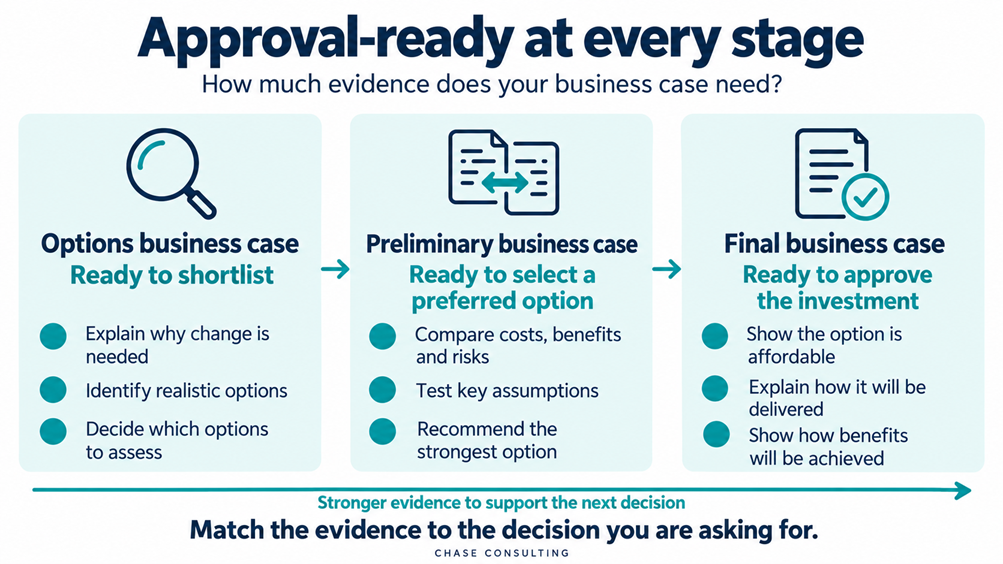
Options business case: ready to shortlist
At this stage, explain why action is needed and identify realistic alternatives, including continuing with current arrangements where appropriate.
Use available information and indicative costs, benefits and risks to compare options. Explain why some warrant detailed assessment and others do not.
Approval-ready means decision-makers can agree on the shortlist and understand what further assessment will involve. Avoid detailed forecasts that suggest greater accuracy than the evidence supports.
Preliminary business case: ready to select a preferred option
Build enough comparative evidence to recommend the strongest option. Use feasibility assessments, cost estimates and financial modelling alongside practical testing where needed.
For a market expansion, this could mean comparing locations and entry methods, then testing customer demand through a limited sales trial.
Approval-ready means the preferred option is supported by evidence. State what still needs checking, how those questions will be answered and what resources are required to develop the option further.
Final business case: ready to approve the investment
Support your cost estimates and expected benefits with evidence. Explain the main risks and how the preferred option will be delivered.
For the market expansion, use trial sales, customer feedback and delivery costs to strengthen the forecasts. Explain how results might differ at a larger scale.
Approval-ready means decision-makers can judge the investment and its risks. Where important questions remain, propose staged funding, review points and clear conditions for continuing or changing direction.
Apply the 5 Step Framework at every stage
Chase Consulting’s 5 Step Framework provides a consistent process across all three business case stages:
Confirm the opportunity: Clarify the decision, what is known and what still needs checking.
Analyse and shortlist the options: Consider credible alternatives and identify the assessment needed.
Evaluate the options: Compare the evidence, using analysis and practical testing as appropriate.
Develop the implementation strategy: Explain delivery responsibilities, progress measures and how changes will be managed.
Draw the options conclusion and approval pathway: Recommend the next step supported by the evidence.
The journey is ready to shortlist, select a preferred option, and approve the investment. Match the evidence to the decision you are asking for.
Client example: IMCD’s supply chain investment
IMCD Australia needed to improve customer service, sales forecasting and inventory management. Chase Consulting developed the business case for an advanced planning and optimisation system, presenting it to decision-makers on the Australian and international boards.
Following implementation, IMCD achieved 10% sales growth, a 25% reduction in inventory and a 50% reduction in aged stock. The financial benefits exceeded the business case projections.
The practical lesson: identify measurable benefits before seeking approval, then track actual results after implementation.
Read the IMCD supply chain business case.
Does your business case have the evidence it needs?
If you are preparing an options, preliminary or final business case, I can help you identify missing evidence, strengthen your recommendation and clarify the decision you are asking for.
Get practical support through a business case review, coaching or a tailored workshop.